• HOME
  • ABOUT US
    • About Us
    • Committee
    • Code of ethics
    • Constitution and Rules
  • THE BREED
    • THE BREED
    • STANDARD
    • PUPPIES
    • HEALTH
    • HISTORY
  • JUDGING
  • SHOWS
    • SHOWS
    • OPEN SHOWS
    • CHAMPIONSHIP SHOWS
    • SHOW CALENDAR 2026
    • INTER CLUB MATCH
  • BREED COUNCIL
  • EVENTS
  • MEMORABILIA
  • LINKS
  • CONTACT US
The Southern Rhodesian Ridgeback AssociationThe Southern Rhodesian Ridgeback Association
  • HOME
  • ABOUT US
    • About Us
    • Committee
    • Code of ethics
    • Constitution and Rules
  • THE BREED
    • THE BREED
    • STANDARD
    • PUPPIES
    • HEALTH
    • HISTORY
  • JUDGING
  • SHOWS
    • SHOWS
    • OPEN SHOWS
    • CHAMPIONSHIP SHOWS
    • SHOW CALENDAR 2026
    • INTER CLUB MATCH
  • BREED COUNCIL
  • EVENTS
  • MEMORABILIA
  • LINKS
  • CONTACT US
CLICK HERE FOR THE 2022 RHODESIAN RIDGEBACK HEALTH SURVEY
Juvenile Myoclonic Epilepsy - JME
Juvenile Myoclonic Epilepsy Testing

Rhodesian Ridgeback Breed Health

The Rhodesian Ridgeback is in general a healthy breed, however as with all breeds there are some conditions that we need to be made aware of.

Hip and elbow scores and JME results are all recorded by the Kennel Club and are available on their website which you can visit by clicking here.

Breeders are required to test for the following conditions:

Hip and elbow dysplasia

The SRRA recommends that all breeding stock is scored for Hip Dysplasia. It is also desirable to score the elbows of breeding stock.

For more information about Hip Dysplasia click here

For more information about Elbow Dysplasia click here

Degenerative Myelopathy

For more information about Degenerative Myelopathy click here

Juvenile Myoclonic Epilepsy – with kind permission of Alison Pearce.

Juvenile Myoclonic Epilepsy in Rhodesian Ridgebacks (JME) JME was only recognised in 2015 after extensive research was carried out at two Universities.

The University of Munich doing clinical examinations by a research team led by Professor Andrea Fischer.

The University of Helsinki where Hannes Lohi and his research team were learning the inheritance patterns of JME.

Nina Lindqvist (A Rhodesian Rhodesian breeder and the Chairman of the Rhodesian Ridgeback club of Finland) has been working hard along side Prof Fischer and Prof Lohi as the JME co-ordinator getting information to a Facebook page (Myoclonic Epilepsy in Rhodesian Ridgebacks) and being on hand to answer any questions.

JME is an inherited defect only in Rhodesian Ridgebacks, It is from a recessive mode of inheritance which means an affected dog would have inherited two copies of the mutation… One from each parent.

A Carrier of JME would have inherited only one copy of the mutation… From only one parent.

A dog Clear of JME obviously does not have any copies of the mutation.
See the following chart to help you understand the inheritance patterns of JME.

The symptoms of JME are untypical to the more common Epileptic symptoms.

Symptoms of JME are frequent twitches and myoclonic muscle jerks usually when the dog is sleeping or resting. All affected dogs have been of a young age ranging from 6 weeks to 18 months when symptoms were first noticed. Some dogs can also develop more severe tonic-clonic seizures (Grand Mal seizures) these seizures are more typical types of seizures associated with Epilepsy in general.

Photo sensitivity has also been noticed in some affected dogs. These dogs have reacted to flashing lights.

There is now a commercial test available for all Rhodesian Ridgebacks. Here in the UK we can test at Laboklin (​www.laboklin.co.uk​) It is just a simple blood sample or buccal swab carried out and verified by your vet.

The test will determine the JME status of your Rhodesian Ridgeback, either CLEAR, CARRIER or AFFECTED of JME.

There are treatments available which can reduce the symptoms of JME, some have even stopped the symptoms completely with very carefully managed medication.

There are some cases which are more tricky to manage. As with all medications, Anti-Epileptic Drugs can carry some nasty side effects as the body in some cases can not tolerate these drugs. For example.. some Rhodesian Ridgebacks have suffered with lethargy, anxiety, sedation, loss of co-ordination and more. It is important to monitor your dog when on any Anti-Epileptic Drugs. Vets in the UK are not all familiar with JME but Prof Andrea Fischer or Nina Linqvist are always available to discuss treatments with your vet or yourself.

Alison Pearce.

Dermoid sinus

Dermoid sinus is present at birth; in other words, it is congenital. It is categorised as a neural tube defect and involves a hollow tube, sometimes not much bigger than a thread. This tube penetrates down into the skin tissues. It has variable grades of depth, and in worst-case scenarios it will bore down to the spinal cord. Dermoid sinus can be found along the dorsal line of the back, anywhere from the base of the head down to the base of the tail. Dermoid sinus can present itself in a number of ways; it can involve hair follicles, sebaceous glands and sweat glands, or it can present as a small opening in the skin. Often a dermoid sinus will become infected. This can cause serious health issues and can in some cases become life-threatening. There are five different grades of dermoid sinus.

Breeders should check a new litter of puppies for this condition once they and the dam have settled, usually a few days from the birth. This is done by very gently palpating along the dorsal line. This requires experienced fingers and should only be attempted by those who are competent in the procedure. Some dermoid sinus can be visibly seen by eye, and will usually manifest in a collection of hair and sebaceous fluid. The litter requires checking several times throughout their time with the breeder, and you should have two other experienced breeders on hand to clarify the dermoid sinus status of each puppy.

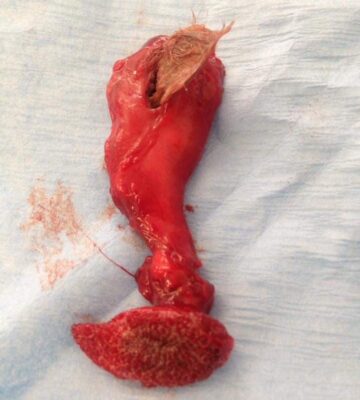
Example of a Dermoid Sinus that has been removed

If left, a dermoid sinus will cause pain and suffering; it is vital that breeders recognise and act on the problem efficiently and appropriately.

In years gone by, the only option for a puppy that presented with a dermoid sinus was to have them put to sleep. Thankfully nowadays, most cases are operable, and these puppies can go on to live a normal life. Although all surgical procedures carry a risk, the surgery for dermoid sinus is normally a fairly straightforward operation.

However, you should only use a vet that has knowledge of dermoid sinus and experience in this field of surgery. Any puppy diagnosed with dermoid sinus should not be bred from and breeders must make this crystal clear to the new puppy owners and include a clause in their puppy contract stating that the puppy must be neutered or spayed at the appropriate age to avoid unwanted pregnancies. The puppy concerned should be sold to its new owners at rearing costs only

There are several theories as to what causes a dermoid sinus. One is that it is as a result of a recessive gene and therefore the puppy must receive one defective gene from both the sire and the dam in order to develop the condition. Another is that it involves multiple genes; this is classed as polygenic. Some studies have also shown that the inclusion of folic acid in the dam’s diet can reduce and prevent the incidences of dermoid sinus. It has also been found that taking folic acid at the key stages of neural tube development – pre-mating and for the first 3–4 weeks of pregnancy – can reduce the number of puppies affected. Folic acid can be given in a supplement form, but I prefer to provide it in its natural state and include foods rich in the nutrient in the dam’s diet (e.g. spinach). I also feed a nutrient-rich, natural diet. I have to date bred 5 litters over 15 years, resulting in a total of 76 puppies, and of these I have only ever experienced 1 puppy affected by dermoid sinus. This puppy was a bitch from our very first breeding. I must add that coincidently the dam was raised on a kibble-based diet. All our subsequent breedings have only ever known a raw, natural diet. In the 1990s a study was conducted with the approval of The Rhodesian Ridgeback Club Of South Australia.

The results were quite outstanding, with a clear reduction in the number of puppies born with dermoid sinus. Interestingly enough, those dams given a natural source of folic acid produced less puppies affected than those given a synthetic supplement. I am including a link to the study for your information. It is an interesting read.

Rhodesian Ridgebacks are not the only breed that have a predisposition to this condition. Other breeds include Thai Rhodesian Ridgebacks, Shih Tzus, Boxers, Rottweilers, Boerboels, Siberian Huskies and Golden Retrievers.

If you are a new breeder, then I would suggest you contact the breed clubs and speak with their health coordinator, who will be able to advise you and suggest an experienced breeder who can check your litter for you. Over a period of years as you gain experience, you will learn how to check for the condition yourself.

If you are an interested in owning a Rhodesian Ridgeback in the future, then please ensure you ask the breeders you contact about the condition. You would be wise to find a reputable and responsible breeder through any of the breed clubs listed here.

Finally, remember that, despite this condition, Rhodesian Ridgebacks are overall a very healthy breed.

Image with kind permission of Li Gessbo.
Above is an image showing the five different grades of dermoid sinus.
©️copyright by Mandy Maidment 2020

Dermoid sinus surgery and post operative care guide
Dermoid Sinus Surgeons UK

We are here to help not just members, but anyone who needs help with their ridgeback. We have experts on our Committee with a wealth of knowledge we can call on. We have a list of vets that have successfully performed the surgery. If you would like our help for any health issues, please contact our Health Co-ordinator.

Useful links

An interesting study by Nicolette Salmon Hillbertz can be found by clicking here

The Rhodesian Ridgeback Club Of South Australia – Folic Acid Study – click here

Information on Inherited Ventricular Arrhythmia in the Rhodesian Ridgeback, courtesy of GenoCan – click here

Non breed specific health conditions

Bloat (GDV) – A life threatening condition that can occur in deep chested breeds – click here

Lungworm – A parasitic worm that can affect dogs – click here

Alabama Rot – A life threatening disease that affects dogs – click here

Articles

Stelfonta treatment for dogs with Mast Cell Tumours, with kind permission of Molly Jacobson and dogcancerblog – click here

Quick links

For Schedules for U.K. Championship Shows and Results

Higham Press

Fosse Data Systems

Interested in a rescue?

Rhodesian Ridgeback Welfare Trust

Taking your pet abroad

Linda Johnstone Photography

Contact Us

Find us on social

© 2026 · Southern Rhodesian Ridgeback Association